

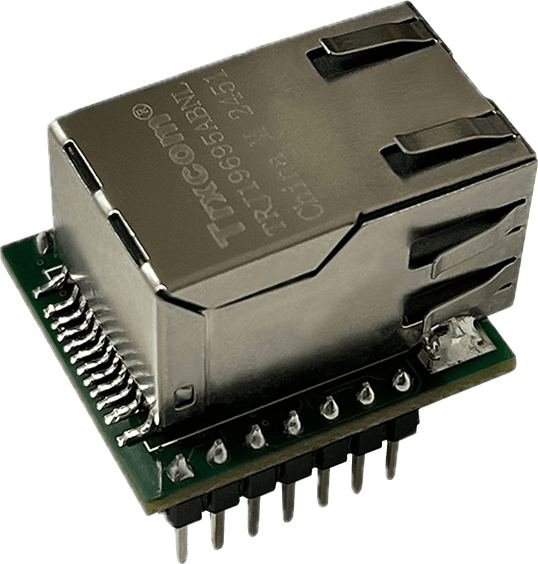
Serial communication remains widely used in industrial equipment, measurement instruments, controllers, and embedded systems.
However, modern applications increasingly require these devices to communicate over Ethernet networks, integrate with monitoring systems, or exchange data with IoT platforms.
The PP-Ethernet-UART-MINI provides more than basic Serial-to-Ethernet conversion. In addition to bridging UART and Ethernet communication, it supports Modbus protocol conversion and MQTT connectivity, making it suitable for industrial networking, remote monitoring, and IoT applications.
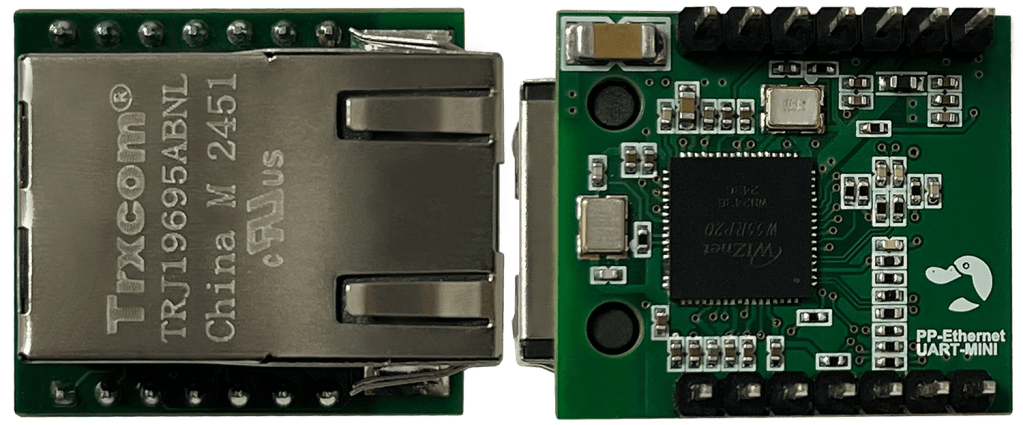
More Than a Serial-to-Ethernet Converter
At its core, the module connects a UART-based device to an Ethernet network.
A typical communication path is:
Serial Device → UART → PP-Ethernet-UART-MINI → Ethernet → Network
And in the reverse direction:
Network → Ethernet → PP-Ethernet-UART-MINI → UART → Serial Device
This allows existing serial equipment to communicate with PCs, servers, gateways, or other network-connected systems without changing the original serial interface.
Beyond transparent Serial-to-Ethernet communication, the module also provides protocol-level features for industrial and IoT applications.
Modbus TCP and Modbus RTU/ASCII Conversion
Modbus is one of the most widely used communication protocols in industrial automation.
Many field devices still communicate using Modbus RTU or Modbus ASCII over serial interfaces, while newer control and monitoring systems often use Modbus TCP over Ethernet.
PP-Ethernet-UART-MINI can bridge these two environments.
A typical configuration is:
Modbus RTU Device → Serial → PP-Ethernet-UART-MINI → Ethernet → Modbus TCP Client
This makes it possible to connect existing serial Modbus devices to Ethernet-based systems without replacing the original equipment.
Typical applications include:
- PLC and controller integration
- Factory automation
- Industrial sensor networks
- Measurement equipment
- Building automation
- Modbus gateway applications
This protocol conversion capability makes the module particularly useful for upgrading legacy serial systems to Ethernet-based industrial networks.
MQTT for Remote Monitoring and IoT
In addition to Modbus, PP-Ethernet-UART-MINI supports MQTT, a lightweight publish/subscribe protocol commonly used in IoT and remote monitoring systems.
With MQTT support, data received from a serial device can be delivered over Ethernet to an MQTT-based application or server.
A typical architecture can be represented as:
Serial Device → UART → PP-Ethernet-UART-MINI → Ethernet → MQTT Broker
This enables existing UART-based equipment to participate in networked monitoring and IoT applications without requiring MQTT functionality to be implemented in the original device.
MQTT connectivity can be useful for applications such as:
- Remote equipment monitoring
- Environmental monitoring
- Data logging
- Factory monitoring
- IoT gateways
- Equipment status reporting
- Centralized monitoring systems
For developers working with existing serial products, this provides a practical way to add network-level data communication while keeping the original device architecture unchanged.
One Module, Multiple Communication Options
Depending on the application, PP-Ethernet-UART-MINI can be used in several communication scenarios.
Serial-to-Ethernet
UART Device ↔ Ethernet Network
For transparent network communication with existing serial equipment.
Modbus Gateway
Modbus RTU/ASCII ↔ Modbus TCP
For integrating serial Modbus devices into Ethernet-based industrial networks.
MQTT Connectivity
UART Device → MQTT Network
For transferring serial device data to remote monitoring or IoT systems.
These different operating options allow the same module to be used across a wide range of embedded and industrial applications.
Hardware Interface and Pinout
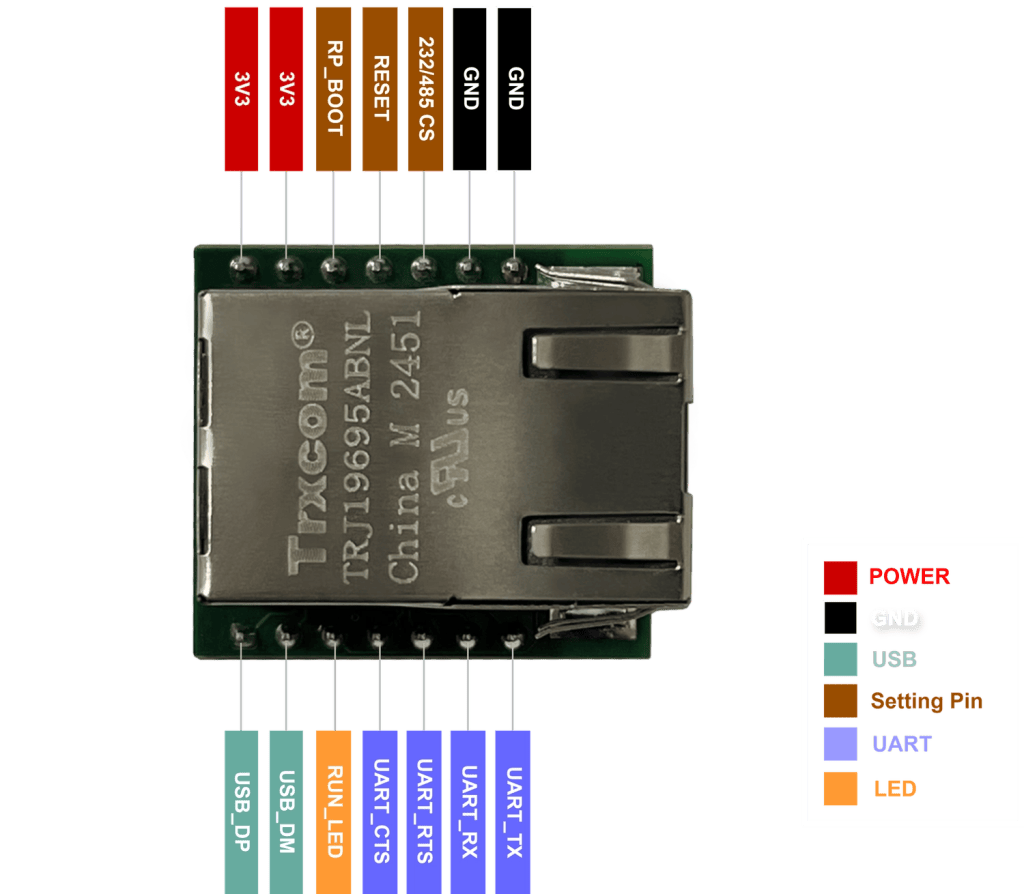
PP-Ethernet-UART-MINI provides a simple hardware interface for integration with embedded systems.
The module exposes the essential UART and control signals required for Serial-to-Ethernet applications:
- 3.3V / GND – Power supply and ground
- UART_TX / UART_RX – Serial data transmission and reception
- UART_RTS / UART_CTS – Hardware flow control signals
- RESET – Hardware reset input
- RP_BOOT – Boot mode control for firmware programming
- USB_DP / USB_DM – USB interface for firmware upload and debugging
- RUN_LED – Module operation status output
The UART interface supports TX, RX, RTS, and CTS, allowing the module to be used not only for basic two-wire UART communication but also in applications requiring hardware flow control.
For a typical Serial-to-Ethernet application, the host MCU can be connected directly through the UART TX and RX signals.
Host MCU TX → UART_RX
Host MCU RX ← UART_TX
When hardware flow control is required, RTS and CTS can also be connected between the host and the module.
The additional RESET, BOOT, and USB signals provide access to firmware management and debugging functions, while RUN_LED can be used by the host system to monitor the operating status of the module.
Flexible Configuration
Network and serial communication parameters often need to be adjusted according to the installation environment.
PP-Ethernet-UART-MINI supports multiple configuration methods, including:
- Ethernet Configuration Tool
- Serial AT Commands
- Web-based configuration
This allows users to configure network settings, serial communication parameters, and operating modes without redesigning or recompiling the host system.
The flexibility is particularly useful for field installation, where parameters such as IP address, baud rate, or communication mode may need to be changed after deployment.
Key Features
Key features of PP-Ethernet-UART-MINI include:
- 10/100 Mbps Ethernet
- UART communication up to 921 kbps
- TX, RX, RTS, and CTS support
- Serial-to-Ethernet communication
- Modbus TCP and Modbus RTU/ASCII conversion
- MQTT support
- Serial AT Command configuration
- Ethernet Configuration Tool
- Web-based configuration
- USB interface for firmware update and debugging
- Unique MAC address
- Operating temperature range from -40°C to +85°C
- ESD protection
Applications
The module can be applied to a wide range of systems, including:
- Industrial automation equipment
- Modbus gateways
- Remote monitoring systems
- PLC and controller networks
- Measurement instruments
- Data acquisition systems
- Building automation
- Serial device servers
- IoT gateways
- Legacy equipment upgrades
Conclusion
PP-Ethernet-UART-MINI is not limited to simple Serial-to-Ethernet conversion.
By supporting Modbus TCP to Modbus RTU/ASCII conversion and MQTT connectivity, it can serve as a communication bridge between existing serial equipment, industrial Ethernet networks, and IoT monitoring systems.
For applications that need to extend legacy UART-based devices with Ethernet, Modbus, or MQTT communication, PP-Ethernet-UART-MINI provides a compact and flexible way to add network connectivity without major changes to the existing system.
Discover more from PLATYPUS
Subscribe to get the latest posts sent to your email.
 PLATYPUS
Leave a comment