
Developing an Ethernet-enabled embedded device involves more than establishing a network connection. Engineers must also consider power delivery, electrical isolation, PCB space, and overall system reliability.
These challenges become particularly important in industrial IoT applications, where devices are often installed in remote locations or environments with limited access to power outlets.
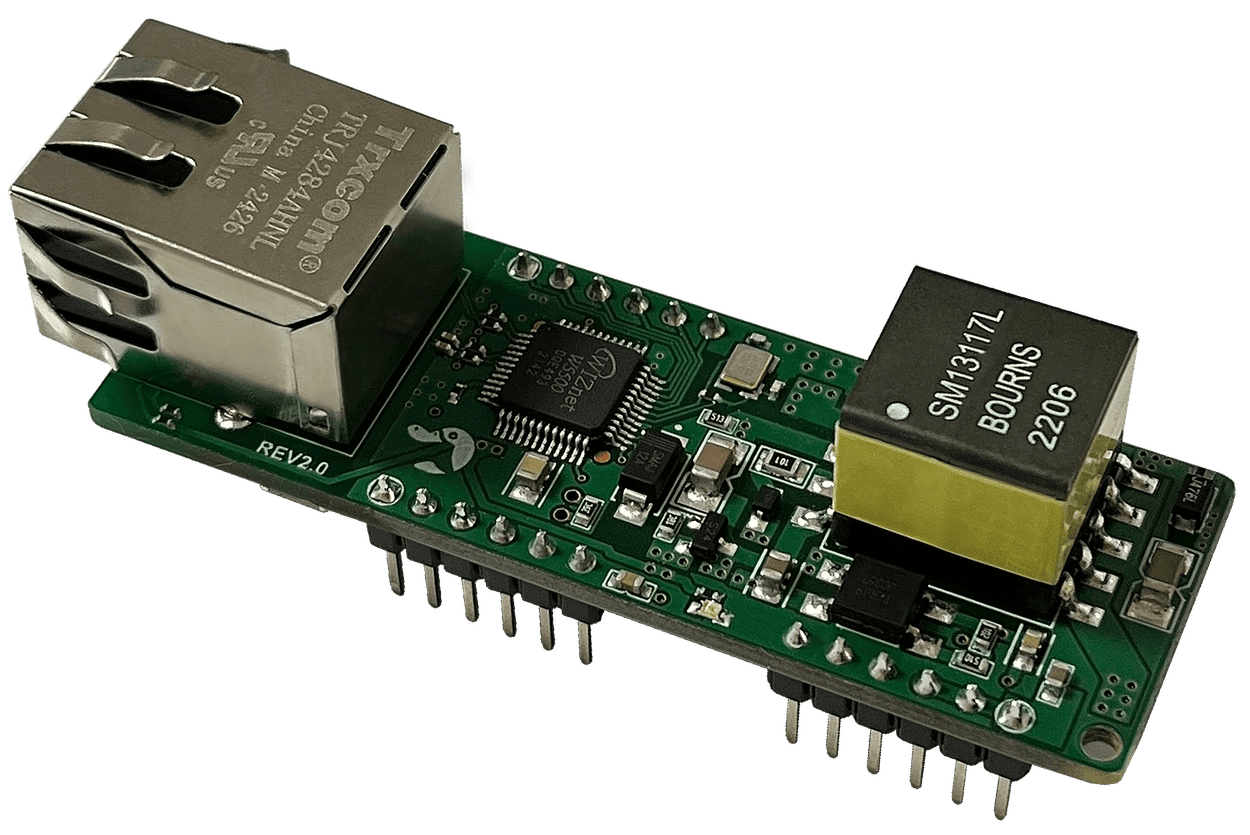
Platypus addresses these challenges with the PP-W5500-POE, a compact Ethernet and Power over Ethernet (PoE) module that combines the WIZnet W5500 Hardwired TCP/IP controller with an isolated IEEE 802.3af-compliant power supply.
By integrating Ethernet communication and PoE power conversion into a single module, the PP-W5500-POE simplifies hardware development and reduces the need for separate networking and power circuitry.
1. WIZnet W5500: Hardware-Based Ethernet Connectivity
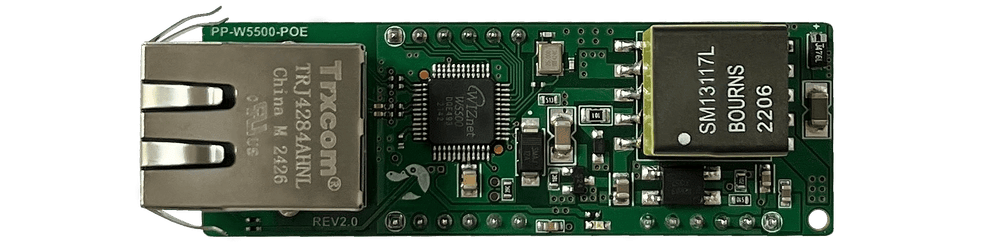
At the heart of the PP-W5500-POE is the WIZnet W5500, a Hardwired TCP/IP Ethernet controller designed to provide reliable network connectivity with minimal host MCU overhead.
Unlike software-based TCP/IP implementations, which require the host processor to handle network protocol processing, the W5500 manages essential TCP/IP functions directly in hardware.
This architecture reduces the processing burden on the host MCU and allows developers to focus on application-specific functionality.
The W5500 provides:
- 10/100 Mbps Ethernet connectivity
- 8 independent hardware sockets
- 32 KB internal TX/RX buffer memory
- High-speed SPI host interface
- Hardware support for TCP, UDP, ICMP, IPv4, ARP, IGMP, and PPPoE
- Integrated Ethernet PHY and MAC
The SPI interface makes the module suitable for integration with various microcontrollers without requiring a separate Ethernet PHY or a software TCP/IP stack.
For embedded systems with limited processing power and memory, this hardware-based approach provides a practical way to implement Ethernet communication.
2. Power over Ethernet: One Cable for Data and Power
One of the most significant advantages of the PP-W5500-POE is its integrated Power over Ethernet functionality.
PoE technology allows both electrical power and network data to be delivered through a single Ethernet cable, eliminating the need for a separate power connection at the device.
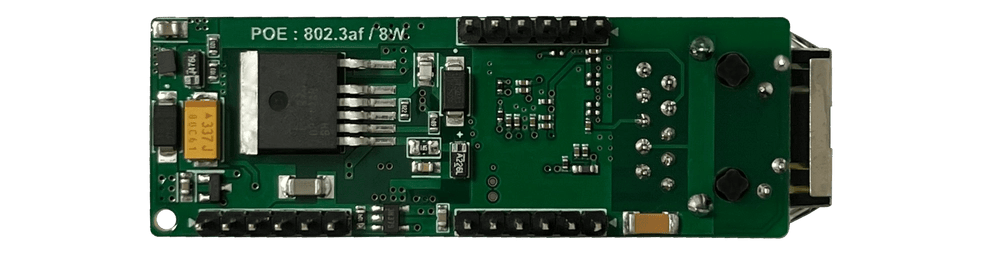
The PP-W5500-POE supports IEEE 802.3af PoE in both Mode A and Mode B, enabling it to receive power from compatible PoE switches and injectors.
The integrated power conversion circuit transforms the incoming PoE voltage into a regulated 5V output that can power the host MCU and additional system components.
PoE Electrical Specifications
| Parameter | Specification |
|---|---|
| PoE Standard | IEEE 802.3af |
| PoE Modes | Mode A and Mode B |
| Input Voltage | 40–60V DC |
| Output Voltage | 5V DC |
| Maximum Output Current | 1.6A |
| Maximum Output Power | 8W |
| Isolation | 2 kVrms |
| Power Conversion IC | Power Integrations DPA423 |
With up to 8W of regulated 5V power, the module can supply not only Ethernet connectivity but also power for a connected embedded system, subject to its overall power requirements.
This integration is particularly useful for remote sensors, industrial controllers, and compact network devices where additional power wiring would increase installation complexity.
3. Isolated Power Design with Integrated Protection
Power reliability is critical in embedded and industrial networking applications, especially when devices are expected to operate continuously.
The PP-W5500-POE incorporates the Power Integrations DPA423 power conversion IC, providing an isolated PoE power architecture with integrated control and protection functions.
Its main power management features include:
- PWM Control: Regulates power conversion through controlled switching operation.
- Soft-Start: Enables a controlled startup sequence to reduce stress during power initialization.
- Auto-Restart: Supports automatic recovery following certain fault conditions.
- Under-Voltage Protection: Protects against excessively low input voltage conditions.
- Over-Voltage Protection: Provides protection against excessive input voltage conditions.
Another important feature is the 2 kVrms isolation between the PoE input and the system side.
This isolation provides an electrical barrier between the incoming PoE power and the connected embedded system, supporting applications where electrical isolation is an important design requirement.
By integrating these power management functions into the module, Platypus module reduces the need for developers to design a complete isolated PoE conversion stage from scratch.
4. Simplified Hardware Integration
The PP-W5500-POE is designed to interface with a host microcontroller through a standard SPI connection and dedicated control signals.
Its digital host interface operates at a 3.3V logic level.
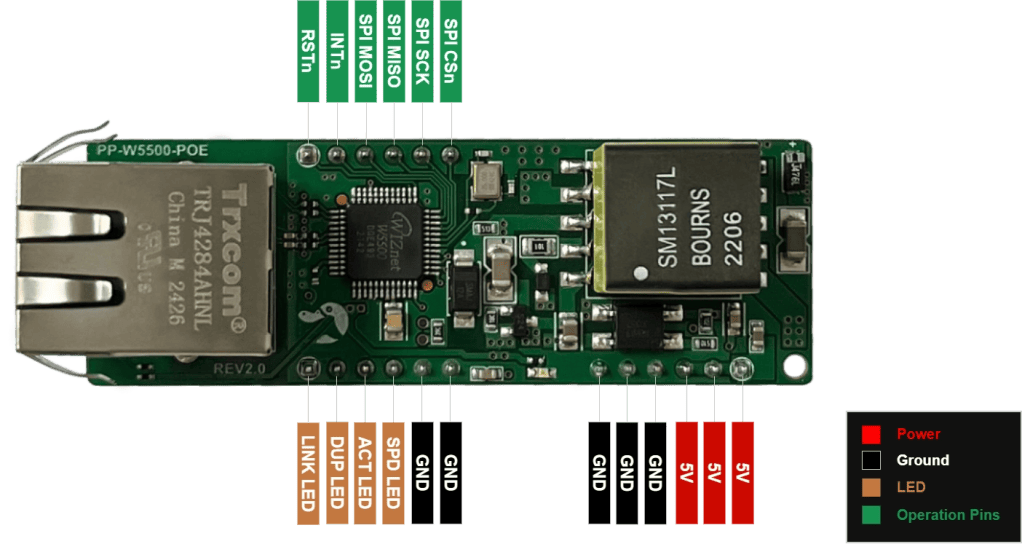
Main Interface Signals
| Signal | Function |
|---|---|
| SPI SCK | SPI Clock |
| SPI MOSI | SPI Data Input |
| SPI MISO | SPI Data Output |
| SPI CSn | SPI Chip Select, Active Low |
| INTn | Interrupt Output, Active Low |
| RSTn | Hardware Reset, Active Low |
| LINK LED | Ethernet Link Status |
| ACT LED | Ethernet Activity Status |
| SPD LED | Ethernet Speed Status |
| DUP LED | Ethernet Duplex Status |
| 5V | Regulated PoE Power Output |
| GND | System Ground |
The module also incorporates an onboard RJ45 connector, further reducing the number of external components needed for an Ethernet-enabled design.
With a compact board size of approximately 65 × 22 mm, the PP-W5500-POE can be integrated into a variety of embedded systems.
Developers can choose between socket mounting and direct solder mounting, depending on the mechanical requirements of their applications.
Platypus also provides an Altium PCB library and STEP model to assist with PCB layout and mechanical integration.
For direct solder mounting, appropriate clearance must be provided for components located on the underside of the module. A PCB cutout may be required in the base board design.
These integration options make it easier to incorporate the module into custom hardware while reducing the effort involved in developing Ethernet and PoE circuitry.
5. Applications: Where Ethernet and PoE Come Together
The combination of hardware-based Ethernet connectivity and isolated PoE power makes the PP-W5500-POE suitable for a wide range of embedded networking applications.
Industrial IoT Controllers
Industrial controllers frequently require reliable Ethernet communication alongside a stable power supply.
The PP-W5500-POE enables developers to add both functions to MCU-based control systems without designing separate Ethernet and PoE circuits.
Remote Monitoring and Sensor Nodes
Remote environmental sensors, monitoring equipment, and data acquisition systems are often installed in locations where dedicated power outlets are inconvenient.
Using PoE, these devices can receive network connectivity and power through a single Ethernet cable, simplifying installation and maintenance.
Smart Building Automation
Building automation systems may include distributed sensors, access control devices, and network-connected controllers.
The PP-W5500-POE can provide a compact communication and power solution for these distributed embedded devices.
Serial-to-Ethernet Gateways
For systems using UART or RS-485 interfaces, a host MCU paired with the PP-W5500-POE can serve as the foundation for a Serial-to-Ethernet gateway.
The W5500 handles Ethernet communication, while the MCU manages serial data processing and application logic.
The module’s integrated PoE power supply can also help simplify deployment in industrial networking environments.
6. Conclusion: Simplifying Ethernet and PoE Development
The Platypus PP-W5500-POE brings together two essential elements of modern embedded networking: WIZnet’s hardware-based TCP/IP communication and isolated Power over Ethernet.
With its onboard W5500 controller, IEEE 802.3af compatibility, regulated 5V/8W power output, and 2 kVrms isolation, the module provides a practical building block for industrial IoT and embedded Ethernet applications.
Rather than developing Ethernet communication and isolated PoE power circuitry separately, engineers can integrate both capabilities through a single module.
For developers building compact, network-connected devices, the PP-W5500-POE offers a convenient way to reduce hardware complexity, simplify integration, and accelerate product development.
Learn More
- Product: Platypus PP-W5500-POE
- Datasheet: PP-W5500-POE Datasheet
- Technical Overview: Easy Ethernet, Safe Power – PP-W5500-POE
- Ethernet Controller: WIZnet W5500
Discover more from PLATYPUS
Subscribe to get the latest posts sent to your email.


Leave a comment